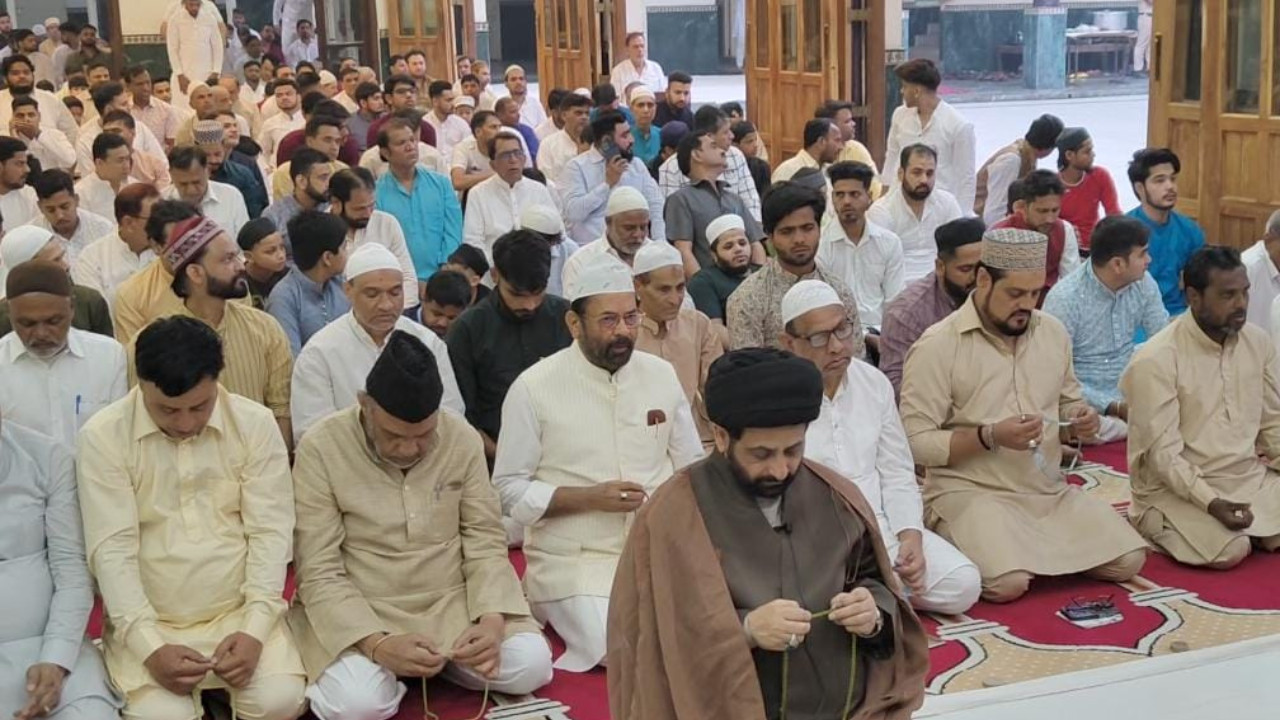
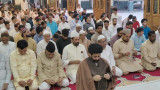
This year, the Eid moon was sighted in Arab nations on March 19; consequently, Eid is being celebrated there today—March 20. (Image X @naqvimukhtar)
New Delhi: The moment the Eid moon is sighted, a wave of excitement sweeps through those observing the fast, as it signifies the completion of the month-long period of fasting. Following this, people offer prayers (Namaz) in remembrance of Allah; thereafter, exchanging greetings of "Chand Mubarak" (Blessed Moon), the observers and their families immerse themselves in preparations for the festival.
In India, the festival of Eid-ul-Fitr is celebrated with great pomp and fervor at iconic locations such as the Jama Masjid in Delhi, the Charminar in Hyderabad, the Aishbagh Eidgah in Lucknow, the Hazratbal Shrine in Srinagar, the Haji Ali Dargah in Mumbai, and Red Road in Kolkata. People gather at these sites to offer Eid prayers and exchange greetings by embracing one another.
Delhi: 6:56 PM
Mumbai: 7:20 PM
Lucknow: 6:42 PM
Srinagar: 7:02 PM
Hyderabad: 6:58 PM
Kolkata: 6:14 PM
Bhopal: 6:59 PM
Observing the fast during the month of Ramadan has been declared a religious obligation (Farz) for every Muslim. This practice serves to allow every individual to experience the sensations of hunger and thirst, thereby enabling them to walk the path of truth and faith. Prophet Muhammad celebrated Eid-ul-Fitr in 624 AD, following the Battle of Badr. On this day, the victory achieved in the battle was celebrated, and sweets were distributed. Since then, the tradition of celebrating Eid-ul-Fitr as "Meethi Eid" (Sweet Eid) has continued. It is worth noting that the Battle of Badr was fought during the month of Ramadan.
The word "Eid" translates to "festival," while "Fitr" signifies the "conclusion of the fast." Thus, it marks the occasion where those who have observed the fast celebrate the culmination of their month-long spiritual discipline. *Fitran* (or *Fitra*) holds immense significance in this context, as the term translates to "charity" or "donation." To ensure that every impoverished individual can partake in the festivities, *Zakat*—a form of charitable giving—is distributed to the needy.
According to the Islamic calendar, the festival of Eid is celebrated on the first day of the month of *Shawwal*. As the holy month of Ramadan concludes on March 20th, the month of *Shawwal* will commence across India on March 21st; on this very day, the Eid prayers (*Namaz*) will be offered, and greetings for Eid-ul-Fitr will be exchanged.
This year, the Eid moon was sighted in Arab nations on March 19; consequently, Eid is being celebrated there today—March 20. It is worth noting that the observance of fasting (*Roza*) also began in Arab countries one day earlier than in India. Similarly, Eid will now be celebrated in India one day later than in the Arab world—specifically on Saturday, March 21.
In the context of the Islamic calendar, Ramadan constitutes the ninth month of the year. During this month, Muslims observe 'Roza' (fasting) while constantly remembering and worshipping Allah. According to Islamic belief—and as prescribed in the Holy Quran—after Muslims have faithfully observed the fasts throughout the month of Ramadan, Allah grants His devotees a special 'Bakhshish' (a divine gift or reward) on a specific day. For this reason, that day is designated as "Eid," a term synonymous with this divine bestowal. This day of divine reward is known as Eid-ul-Fitr.




Copyright © 2026 Top Indian News